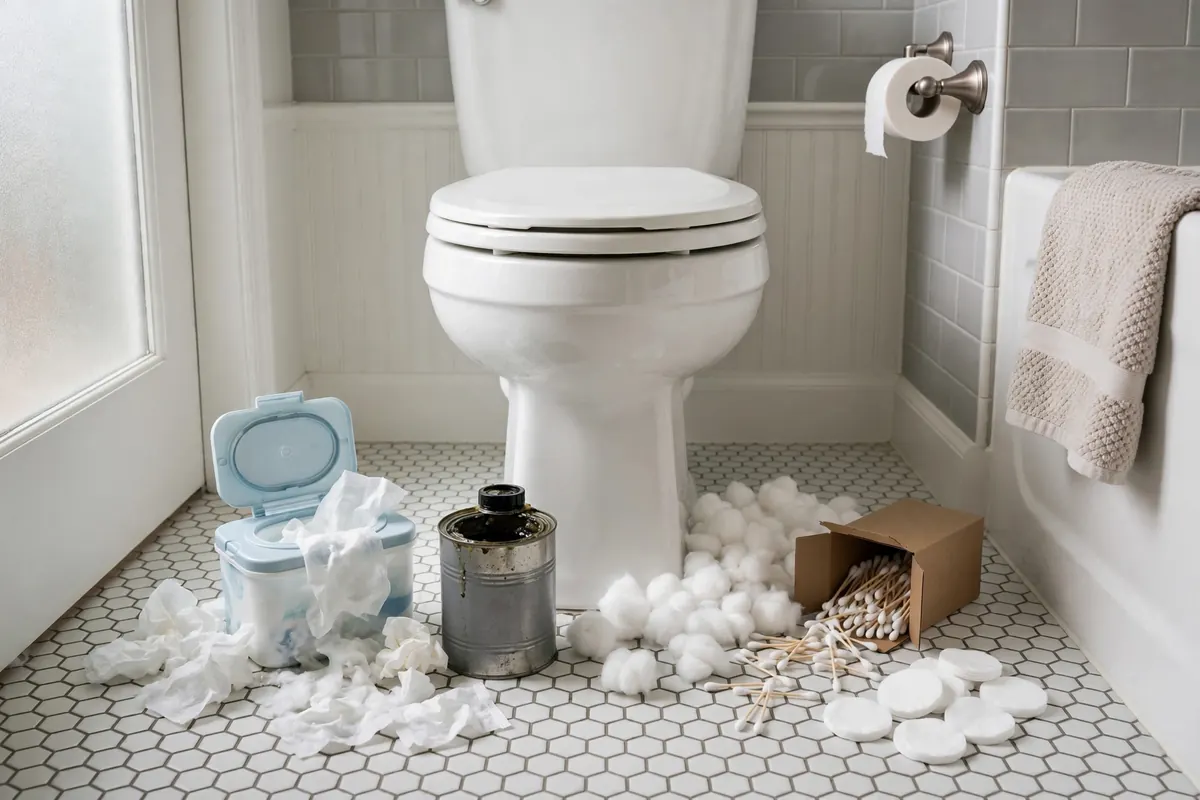
1. "Flushable" Wipes (The Biggest Lie in Your Bathroom)
Let's start here because it's the number one cause of residential sewer clogs we see. "Flushable" wipes do not break down like toilet paper. They don't disintegrate in water — they hold together, snag on pipe joints and roots, and accumulate into masses that can block a lateral completely.
The wipe industry tests flushability with standards that have almost nothing to do with your 60-year-old clay lateral. Toilet paper dissolves in minutes; wipes survive for months. The fix is simple: trash can next to the toilet. Your pipes will thank you.
2. Cooking Grease and Oil
Hot grease goes down liquid and comes back as a solid. It coats the inside of your pipes, cools, hardens, and narrows the passage a little more every time. In Florida's warm climate it stays semi-liquid longer, traveling further into the lateral before setting — which means the blockage forms deeper, where it's harder and pricier to clear.
Wipe pans with a paper towel into the trash, or pour cooled grease into a container and throw it out. "Just a little bit" from every meal becomes a grease clog within a year or two.
3. Coffee Grounds
They feel harmless — tiny, gritty, wash right down. But coffee grounds don't dissolve. They settle in pipe bellies and rough spots, and mixed with grease they form a dense, concrete-like sludge. Garbage disposals don't help; they just move the problem further down the line. Compost them or trash them.
4. Eggshells, Pasta, Rice, and Other Expanding Foods
Eggshell membranes wrap around disposal blades and pipe joints. Pasta and rice swell with water — what went down as a tablespoon becomes a handful inside your pipes. Starchy foods also turn gluey as they break down. Scrape plates into the trash before rinsing, disposal or not.
5. Feminine Hygiene Products and Diapers
Designed to absorb and expand — the exact opposite of what you want in a pipe. These are responsible for some of the most severe residential blockages, and they can damage pipes when they swell against joints. Trash, always. No exceptions, no "just this once."
6. Cotton Balls, Swabs, and Dental Floss
Cotton doesn't break down in water. Floss is worse — it's effectively string, and string wraps around everything: roots, joints, other debris, forming nets that catch everything behind them. A wad of floss and cotton can seed a clog that grows for months before you notice the slowdown.
7. Paper Towels and Tissues
Paper towels are engineered to stay strong when wet — that's the whole point of the product, and it's why they don't belong in pipes. Facial tissues are softer but still far more durable than toilet paper. Only actual toilet paper goes in the toilet. Everything else goes in the bin.
8. Medications
Flushing old pills doesn't clog pipes, but it poisons waterways. Wastewater treatment doesn't fully remove pharmaceuticals, and in Florida they end up in the aquifer, rivers, and the Gulf. Manatee County and most pharmacies take back unused medications — use those programs instead.
9. Cat Litter (Even the "Flushable" Kind)
Clay litter hardens with moisture — pour water on it and watch what happens, then imagine that inside your lateral. Even "flushable" litters can clump in pipes, and litter carries parasites that treatment plants aren't designed to neutralize. Bag it, trash it.
10. Harsh Chemical Drain Cleaners
Yes, the drain cleaner itself belongs on this list. Caustic chemicals generate heat that can soften PVC and crack older pipes, they rarely clear the actual obstruction (roots, bellies, collapsed sections), and they create a chemical hazard for anyone who later works on the line. For the full story, read our post on what drain cleaners do to pipes. Use a plunger or a drain snake for minor clogs — and call for professional drain cleaning when clogs keep returning.
The One Rule That Covers Everything
If it isn't toilet paper or what came out of you, it doesn't go in the toilet. If it isn't water, soap, or small food particles headed for a disposal, be skeptical about the sink. Sewer lines fail from the accumulation of a thousand small bad decisions, not one dramatic mistake. The cheapest sewer repair is the one you never need — and it starts at the drain.
The Kitchen Sink Hall of Shame
Bathrooms get the blame, but kitchens destroy plenty of pipes. Beyond grease and coffee grounds:
- Fibrous vegetables — celery, asparagus, artichoke leaves, corn husks. The fibers wrap around disposal blades and pipe joints exactly like dental floss does, forming nets that catch everything behind them.
- Bones and pits — they don't grind down; they jam disposals and lodge in pipes. Even small fish bones accumulate.
- Flour and dough — flour plus water makes paste, then glue, then a rock-hard mass. Bakers: wipe the bowl before washing.
- Oatmeal and expandable starches — like rice and pasta, they swell dramatically with water and turn to sludge in the line.
- Eggshells (yes, again — they're that common) — the membrane wraps, the grit settles. Compost them.
- Paint — latex paint poured down drains coats pipes and hardens; oil paint is worse. Let it dry and trash it, or use paint hardener.
The pattern: anything that expands, hardens, wraps, or coats doesn't belong in the drain. When in doubt, the trash can is always the safe choice.
What About Garbage Disposals?
Disposals inspire false confidence. They grind food small — but small food still travels into your lateral, where it can settle in bellies, feed grease buildup, and contribute to clogs. A disposal doesn't change what's safe; it just changes the particle size of the mistake.
Use the disposal for what it's for: the small food particles left after scraping plates into the trash. Not as a substitute for the trash can. And never put the fibrous, starchy, or greasy items above through it — grinding them just distributes the problem more evenly through your pipes.
If your home is on a septic system (common in Myakka City and rural pockets), be even more conservative — disposals add solid load the tank must handle, and many septic professionals recommend against heavy disposal use entirely.
Teaching the Household (and Guests)
The hardest part isn't knowing the rules — it's getting everyone else to follow them. A few things that actually work:
- The bathroom trash can. Non-negotiable in every bathroom. If there's nowhere to put a wipe except the toilet, the toilet wins. Remove the excuse.
- A note for guests. Nobody wants the conversation; a small framed note in the guest bath ("our old pipes thank you — please bin wipes and hygiene products") prevents the awkward and the expensive.
- Kids. "Only toilet paper in the toilet" is a rule even toddlers can learn. The toy-flushing phase passes faster with a trash can nearby and a lid lock if needed.
- Rental properties. Landlords: put drain rules in the lease or a welcome sheet. Tenants don't know your 1962 clay lateral can't handle what their last apartment's PVC could. A paragraph now beats a backup later.
Sewer lines fail from the accumulation of a thousand small decisions made by everyone in the house. Make the right decision the easy one, and the pipe takes care of itself.
When the Damage Is Already Done
If you're reading this after years of generous flushing, don't despair — but do get a camera inspection. Years of grease, wipes, and coffee grounds leave a record inside the pipe, and knowing whether you're dealing with buildup (cleanable) or damage (repairable) determines everything. A hydro jetting can reset a greasy, scaled line to near-new condition — and then the rules above keep it that way. The past is sunk cost; the future is a trash can.
Need help with your sewer line?
We serve Bradenton and all of Manatee County. A camera inspection is the fastest way to know what's going on.
Call (941) 214-9486